Build Your Own Prop Firm Platform
Starting a futures prop firm? The full technology stack a firm needs in 2026, what each part costs where prices are published, and which parts to buy instead of build.
- 1. Execution rail: order routing and market data (Rithmic or Tradovate)
- 2. Evaluation accounts and rule engine (drawdown, daily loss, consistency)
- 3. Sales site, checkout and CRM
- 4. KYC, funded-account agreements and payouts
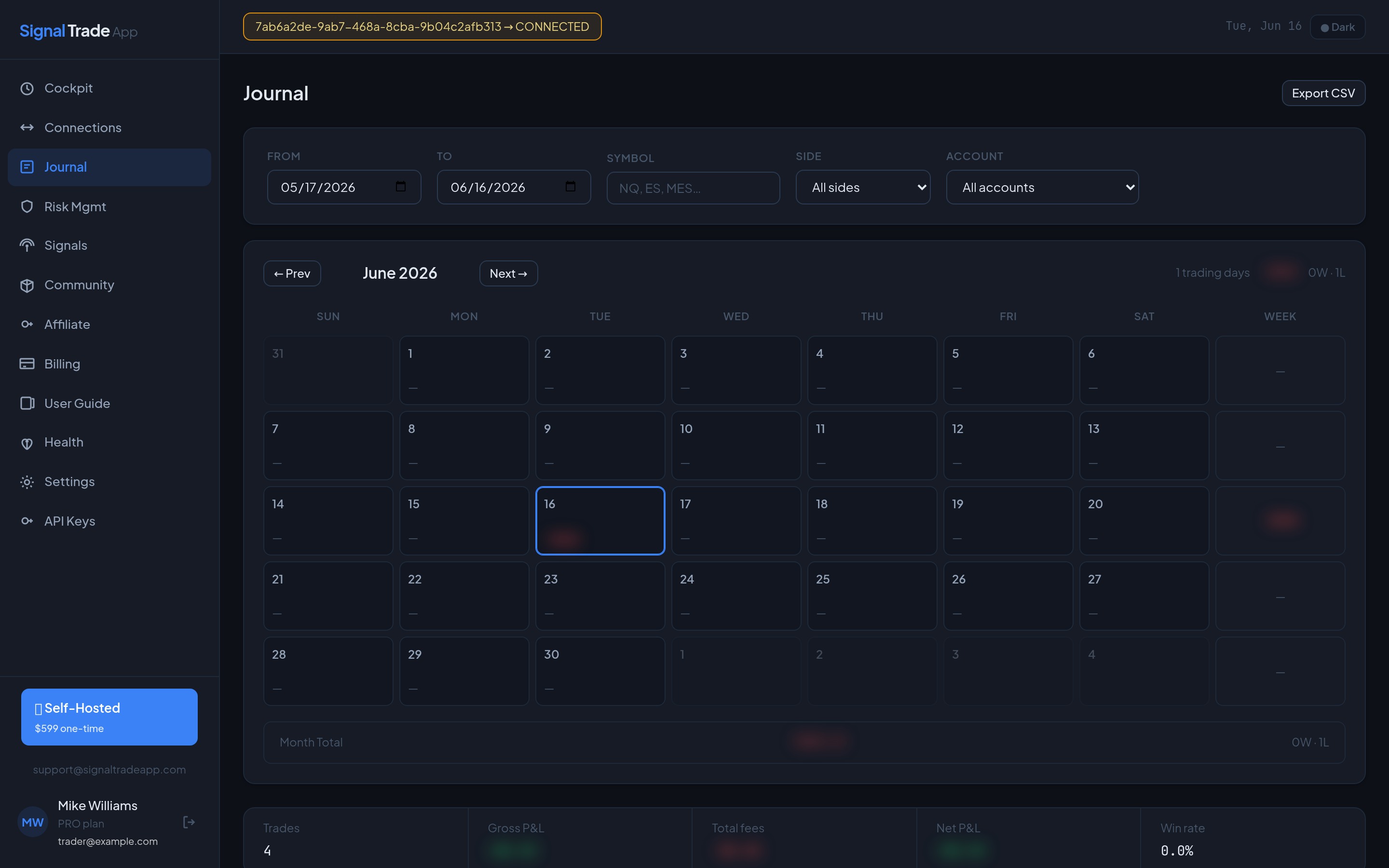
- 5. Trader platform: charts, copier, risk view, journal — Signal Trade App
- 6. Support, community and marketing
Step 1: Choose Your Execution Rail
Most futures prop firms run on Rithmic or Tradovate. Rithmic provides order routing, market data and a server-side risk system, with the R|Trader Pro desktop and wide third-party platform support (NinjaTrader, Quantower and others). Tradovate, part of NinjaTrader Group, offers a web, desktop and mobile platform with a prop programme ("Tradovate Prop") that lists risk controls such as daily loss caps and profit targets, TradingView charts and group trading.
Your rail decides what you pay per user, which platforms traders can use and how evaluation rules are enforced. Signal Trade App works on both, so this choice does not lock you out of a branded trader platform.
| Rithmic | Tradovate | |
|---|---|---|
| Platforms | R|Trader Pro desktop plus many third-party platforms | Own web, desktop and mobile platform |
| Risk tools | Server-side risk incl. auto-liquidate on loss limit or trailing balance | Risk controls incl. daily loss caps, profit targets, trailing drawdown |
| API | R|Protocol (WebSocket + protobuf) | REST + WebSocket |
| Retail reference fee | $25/month per user ID via FCMs such as AMP | Not published for firms |
Step 2: Budget for CME Market Data
Every trader who sees real-time CME prices generates an exchange data fee, and per Topstep "the CME charges for market data on simulated accounts" too. Firms either absorb Level 1 (top of book) and sell depth as an add-on, or pass fees through. CME's published fees from June 2026, as reported by Topstep Brokerage, are below; check CME's current fee list before you budget.
Traders on evaluations normally sign the CME agreement as non-professional. A trader classified as professional costs far more, so your onboarding should explain the choice clearly.
| CME data (per user, per month) | Non-professional | Professional |
|---|---|---|
| Level 1, all four CME exchanges | $4.65 | $134.50 per exchange |
| Level 2 depth, all four CME exchanges | $36.50 | — |
Step 3: Evaluation Logic and Rule Enforcement
Evaluations live or die on accurate rules. Define each one precisely in your terms and configure it at the broker or in your back office so it is enforced in one place.
- Static drawdown: a fixed floor below the starting balance
- Trailing (intraday) drawdown: the floor rises with new account highs, including open profit
- End-of-day drawdown: the floor is recalculated from the closing balance each day
- Daily loss limit, profit target, minimum trading days and any consistency rule
Step 4: Payments, Checkout and Payouts
Plan payments early. Stripe lists "funded prop trading" among its prohibited businesses (checked 2026-10-16), so most firms need a processor that accepts the category. You also need a storefront that sells evaluations, provisions accounts, handles resets and pays funded traders, usually through a prop-firm CRM.
Step 5: Legal Structure
We found no CFTC or NFA rule that specifically addresses futures evaluation firms. The best-known enforcement case, the CFTC's 2023 action against My Forex Funds, was dismissed with prejudice in May 2025, with the court sanctioning the CFTC; it did not decide whether the evaluation model itself is regulated. The common structure — a paid evaluation on simulated accounts, then a funded or simulated-funded account with a profit split — is industry practice, not a ruling. Speak to counsel in your jurisdiction before you sell evaluations.
Step 6: Give Traders a Platform Worth Staying For
This is where firms differentiate. Traders want good charts, copy trading across their accounts, a live view of drawdown left and an automatic journal. Sending them to a patchwork of third-party subscriptions costs them money and costs you the relationship.
Signal Trade App gives them all of it, white-labelled under your brand, on the Rithmic or Tradovate accounts you already issue — as low as $5 per user per month.
Buy vs Build
Building the trader layer in-house means broker integrations, reconnect and partial-fill handling, charting, a journal and a copy engine that never double-fills, plus maintenance for every broker API change. Licensing an existing platform takes weeks.
| Option | Control | Cost profile | Time to launch |
|---|---|---|---|
| Build in-house | Full | Engineering team plus maintenance | Many months |
| White label (hosted) | Your brand | Per user per month | Weeks |
| Self-hosted licence | Your brand and servers | Licence plus optional support | Weeks, plus your ops |
Launch Checklist
Before you open sales, make sure each item has an owner.
- Rail chosen and per-user costs agreed (Rithmic or Tradovate)
- CME data policy: what you include, what traders pay
- Rules written precisely and configured where they are enforced
- Payment processor that accepts prop trading
- Checkout, CRM, KYC and payout process
- Terms and risk disclosures reviewed by counsel
- Trader platform branded and tested with demo accounts
- Support desk and community channel ready for launch day
Ready to compare options? Start with the prop firm platform overview, white-label prop firm costs and the prop firm technology providers compared.
This guide is general information, not legal, tax or regulatory advice. Fees quoted were checked on 2026-10-16 and change; confirm each with the provider.
Frequently Asked Questions
How do I start a futures prop firm?
Pick an execution rail (Rithmic or Tradovate), budget for CME data, define and configure your evaluation rules, set up checkout with a processor that accepts prop trading, arrange KYC and payouts, and give traders a platform. Get legal advice for your jurisdiction before you sell evaluations.
Do futures prop firms pay CME data fees on simulated accounts?
Yes. Topstep states that the CME charges for market data on simulated accounts. As reported for June 2026, non-professional Level 1 for all four CME exchanges is $4.65 per user per month and Level 2 is $36.50.
Does a futures prop firm need CFTC registration?
We found no CFTC or NFA rule that specifically addresses evaluation firms, and the main enforcement case (My Forex Funds) was dismissed in 2025 without deciding the question. Take advice from counsel.
Can a prop firm use Stripe?
Stripe lists funded prop trading as a prohibited business (checked 2026-10-16), so most firms use a processor that accepts the category.
Should I build or buy a prop firm trading platform?
Buy the trader platform unless it is your core product. Broker integrations, order-state handling and charting take many months to build and need constant maintenance. A white-label platform launches in weeks.
Does Signal Trade App handle evaluations and payouts?
No. It is the trader-facing platform. Evaluations, rule enforcement at the broker, KYC and payouts stay with your back office.
Related Pages
- Prop Firm Platform — The trader-facing platform for futures prop firms — copy trading, charting, risk tracking and journaling on Rithmic and Tradovate, white-labelled under your brand from as low as $5 per user per month.
- White Label Prop Firm Cost — What it really costs to launch and run a white-label futures prop firm in 2026 — platform, market data, routing, payments and legal — using prices vendors actually publish.
- White-Label Prop Firm Software — Launch a trading platform with your firm's name on it. Copy trading, risk tracking, charts and a journal for futures traders on Rithmic and Tradovate — your brand, our engine.
- Rithmic Prop Firm Platform — Rithmic gives your firm routing, data and risk. Signal Trade App gives your traders a branded web platform on top of it — copy trading, drawdown alerts, charts, a journal and an API.
- Best Prop Firm Technology Providers 2026
For Prop Firms
- Prop Firm Platform — the white-label trader platform for futures firms
- Pricing — as low as $5 per user per month
- Prop firm technology providers compared