What Is a Prop Firm? Complete Guide for Futures Traders
Category: Getting Started | Date: 2026-06-14
<strong>In simple terms:</strong> a prop firm is a company that lends you its money to trade. You pay a small fee to prove you can trade profitably and manage risk, then keep most of the profits you generate.
What Is a Prop Firm?
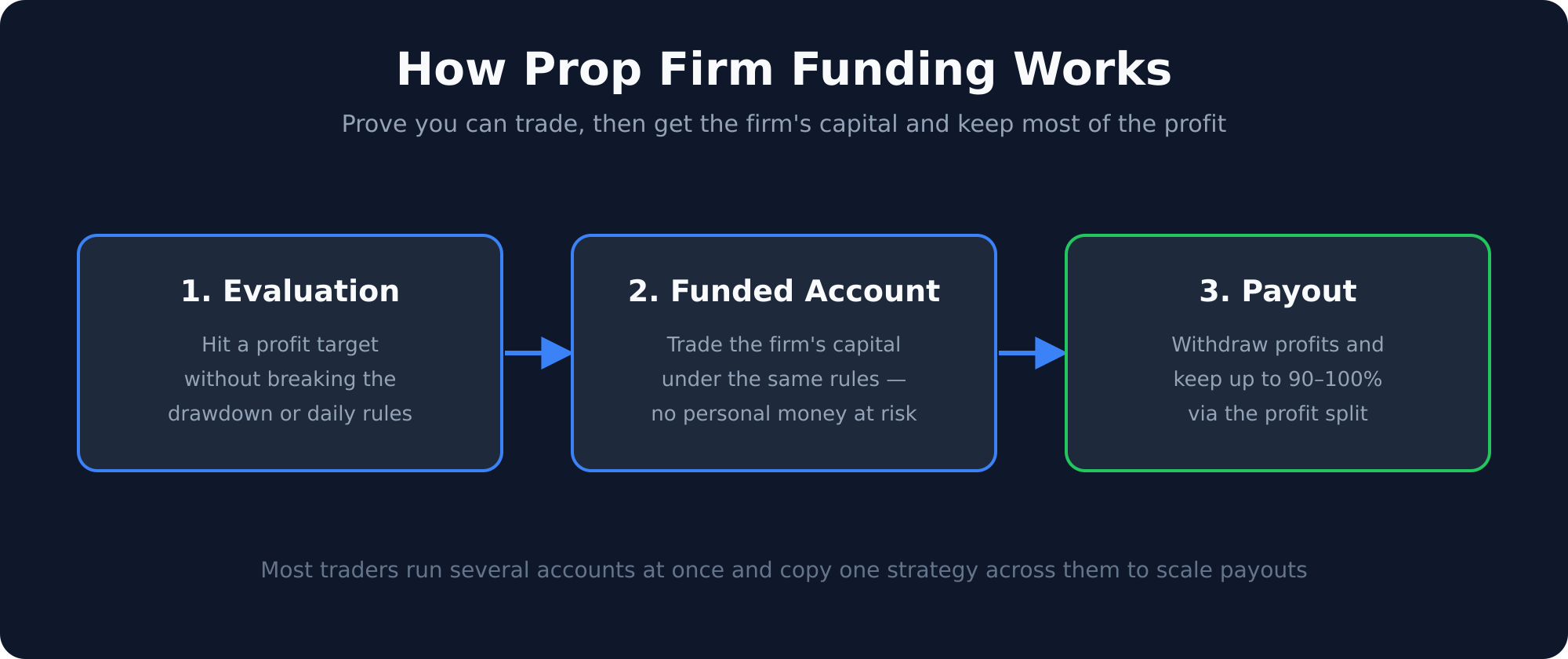
A proprietary trading firm — also called a prop firm or funded trader program — is a company that gives traders access to its capital in exchange for a share of the profits. Instead of risking thousands of dollars of your own money, you pay a small evaluation fee (usually $50–$600) to prove you can trade profitably and manage risk. Once you pass, the firm funds you with a live or simulated account sized from $10,000 up to $300,000 or more.
Prop firms have become especially popular in <strong>futures trading</strong> because they let retail traders scale into professional-sized positions using CME contracts like NQ, ES, MNQ, and MGC without tying up personal capital. The firm takes the downside risk on the funded account; you risk only the evaluation fee.
Quick Definition
A prop firm is a company that funds traders with its own capital. Traders keep 80–100% of profits after passing an evaluation that tests profitability and risk discipline.
Prop Firm vs Trading Your Own Account
The biggest difference between a prop firm and a personal brokerage account is who takes the risk. With a personal account you can lose far more than an evaluation fee. With a prop firm your downside is capped at the evaluation cost, while your upside is scaled by the firm's larger capital.
| Feature | Prop Firm Account | Personal Brokerage Account |
|---|---|---|
| Capital provided | Yes — $10K–$300K+ | No — use your own money |
| Upfront cost | Evaluation fee ($50–$600) | Full account deposit |
| Risk of loss beyond fee | No | Yes |
| Profit split | You keep 80–100% | You keep 100% after costs |
| Scaling potential | High — copy to multiple firms | Limited by personal capital |
How Does a Prop Firm Evaluation Work?
Most futures prop firms use a simple, transparent evaluation process:
- Choose an account size ($10K–$300K) and pay the one-time evaluation fee.
- Trade the evaluation account on a simulated or live-data platform until you hit the profit target.
- Stay within the firm's daily loss limit, maximum drawdown, and any consistency rules.
- Once funded, trade the firm's capital and request payouts on their schedule — usually weekly or bi-weekly.
How Much Does a Prop Firm Cost?
The main cost is the evaluation fee. For a $50,000 futures account, expect to pay roughly $150–$300 for the evaluation. Some firms run promotions that drop the fee to $30–$60. Beyond the evaluation fee, there is no ongoing subscription at most firms — you simply share a percentage of your profits after you are funded.
Prop Firm Rules Explained
Every prop firm protects its capital with clear risk rules. Here are the ones you will see on nearly every evaluation:
- <strong>Daily loss limit (DLL):</strong> The most you can lose in one trading day. Hit it and the account is closed.
- <strong>Maximum drawdown:</strong> The total loss allowed from your starting or highest balance. Some firms use a trailing drawdown that rises with profits; others use a static drawdown from the starting balance.
- <strong>Profit target:</strong> The amount you must earn to pass the evaluation, usually 6–10% of the account size.
- <strong>Consistency rule:</strong> Some firms require no single day to account for more than 30% of your total profits, proving you are a consistent trader.
- <strong>Trading days minimum:</strong> Many firms require at least 3–10 active trading days before you can pass, even if you hit the profit target sooner.
How Do Prop Firm Payouts Work?
After you are funded, you can request withdrawals based on the firm's payout schedule. Common schedules include weekly, bi-weekly, or on-demand after the first payout. Profit splits typically range from 80/20 to 100/0 in the trader's favor, meaning you keep $800–$1,000 of every $1,000 in profits.
Some firms also offer <strong>scaling plans</strong>. If you consistently hit profit targets, the firm increases your account size — for example, from $50,000 to $100,000 — without requiring a new evaluation.
What Can You Trade at a Prop Firm?
Most futures prop firms focus on CME Group products:
- Equity index futures: NQ, MNQ, ES, MES, YM, MYM, RTY, M2K
- Commodity futures: GC, MGC, CL, NG
- Interest rate futures: ZB, ZN, ZF
Micro contracts like MNQ and MGC are especially popular for beginners because they let you control risk with smaller position sizes while still trading the same markets as full-size contracts.
Best Prop Firms for Beginners
If you are new to prop firms, start with one that has a simple rule set and strong reputation:
- <strong>Apex Trader Funding:</strong> No consistency rule, static drawdown, frequent promotions.
- <strong>Topstep:</strong> Longest track record, strong community, a 55% consistency target in the Combine and an end-of-day trailing drawdown; new accounts trade on TopstepX.
- <strong>Take Profit Trader:</strong> Straightforward rules, good for traders who want a simple path to funding.
- <strong>MyFundedFutures:</strong> Competitive pricing and EOD drawdown rules.
Is Prop Trading Right for You?
Prop trading is a good fit if you already have a consistent strategy and disciplined risk management but lack the personal capital to trade at scale. It is not a shortcut to profits — most evaluation attempts fail because traders take too much risk or ignore the rules.
For traders who do pass, the leverage is powerful. A single winning trade can be copied across multiple funded accounts simultaneously using a trade copier, multiplying payouts without multiplying screen time.
Getting Started
The best way to start is simple: pick one prop firm, purchase a small evaluation, and trade it exactly as you would a live account. Focus on passing the evaluation without breaking the rules. Once funded, consider stacking additional accounts and using Signal Trade App to copy your trades across all of them — so every winning trade pays you more than once.
Ready to Scale Your Prop Firm Trading?
Once you are funded at a prop firm, the real opportunity begins: copy your trades to multiple firms at once and multiply your payouts. Signal Trade App lets you trade once and collect payouts from Apex, Lucid Trading and other firms that issue Tradovate or Rithmic logins — with built-in risk management and EOD charts.
Join thousands of prop firm traders who are scaling across multiple accounts with Signal Trade App. Start your free account and copy your first trade today.
Related Reading
How to copy trades across prop firms
Frequently Asked Questions
What is a prop firm and how does it work?
A prop firm is a company that lends you its capital to trade. You pay an evaluation fee to prove you can trade profitably and manage risk, then keep 80–100% of the profits you generate on a funded account.
How much does a prop firm evaluation cost?
Evaluation fees usually range from $50 to $600 depending on account size. A $50,000 futures account typically costs $150–$300, with promotions sometimes dropping fees to $30–$60.
How does a prop firm evaluation work?
You choose an account size, pay the one-time fee, and trade until you hit the profit target while staying within daily loss limits, maximum drawdown, and consistency rules. Once funded, you trade the firm's capital.
What is the difference between a prop firm and trading your own account?
With a prop firm, the firm provides capital and takes the downside risk; your loss is capped at the evaluation fee. With a personal brokerage account, you risk your own money but keep 100% of profits after costs.
What rules do prop firms have?
Common rules include a daily loss limit, maximum drawdown, profit target, consistency rule, and a minimum number of active trading days before passing.
Can you lose more than the evaluation fee at a prop firm?
No. If you hit the daily loss limit or drawdown, the account closes and you owe nothing beyond the evaluation fee you already paid.
What futures can you trade at a prop firm?
Most firms focus on CME Group products, including equity index futures like NQ, ES, MNQ, and MES; commodity futures like GC, CL, and NG; and interest rate futures like ZB and ZN.
How do prop firm payouts work?
After funding, you request withdrawals on the firm's schedule — usually weekly, bi-weekly, or on-demand after the first payout. Profit splits typically range from 80/20 to 100/0 in the trader's favor.
Are prop firms legit?
Established firms like Topstep, Apex Trader Funding, Take Profit Trader, and MyFundedFutures are legitimate with years of payout history. Always research payout track records, rule clarity, and trader reviews before buying an evaluation.
Can you copy trades across multiple prop firms?
Yes. A trade copier connects accounts at different prop firms and copies every trade from your leader account to all followers automatically, letting one winning session generate payouts from multiple firms.
Is prop trading good for beginners?
Prop trading fits traders who already have a consistent strategy and disciplined risk management but lack personal capital. It is not a shortcut to profits — most evaluations fail because traders take too much risk or ignore the rules.
What is the best prop firm for beginners?
Beginners often start with Apex Trader Funding (no consistency rule, static drawdown), Topstep (longest track record), Take Profit Trader (simple rules), or MyFundedFutures (competitive pricing and EOD drawdown rules).
Start Copy Trading Free
Signal Trade App lets you copy one trade across unlimited prop firm accounts in under 50ms. Sign up free with a 5-day Pro trial (credit card required, no charge during trial).
Related Reading
- Help Center — Setup guides, broker connections, and risk management
- Supported Platforms — Tradovate, NinjaTrader, TradingView, and more
- Blog — More guides on copy trading, prop firms, and futures automation