
Trailing Drawdown Explained: The Prop Firm Rule That Trips Most Traders
Category: Prop Firms | Date: 2026-09-24
What Is Trailing Drawdown?
Trailing drawdown is a risk rule used by prop firms where your maximum loss threshold moves upward as your account balance increases. Unlike a static drawdown — which stays fixed at the starting balance — a trailing drawdown follows your highest account value and only moves in one direction: up.
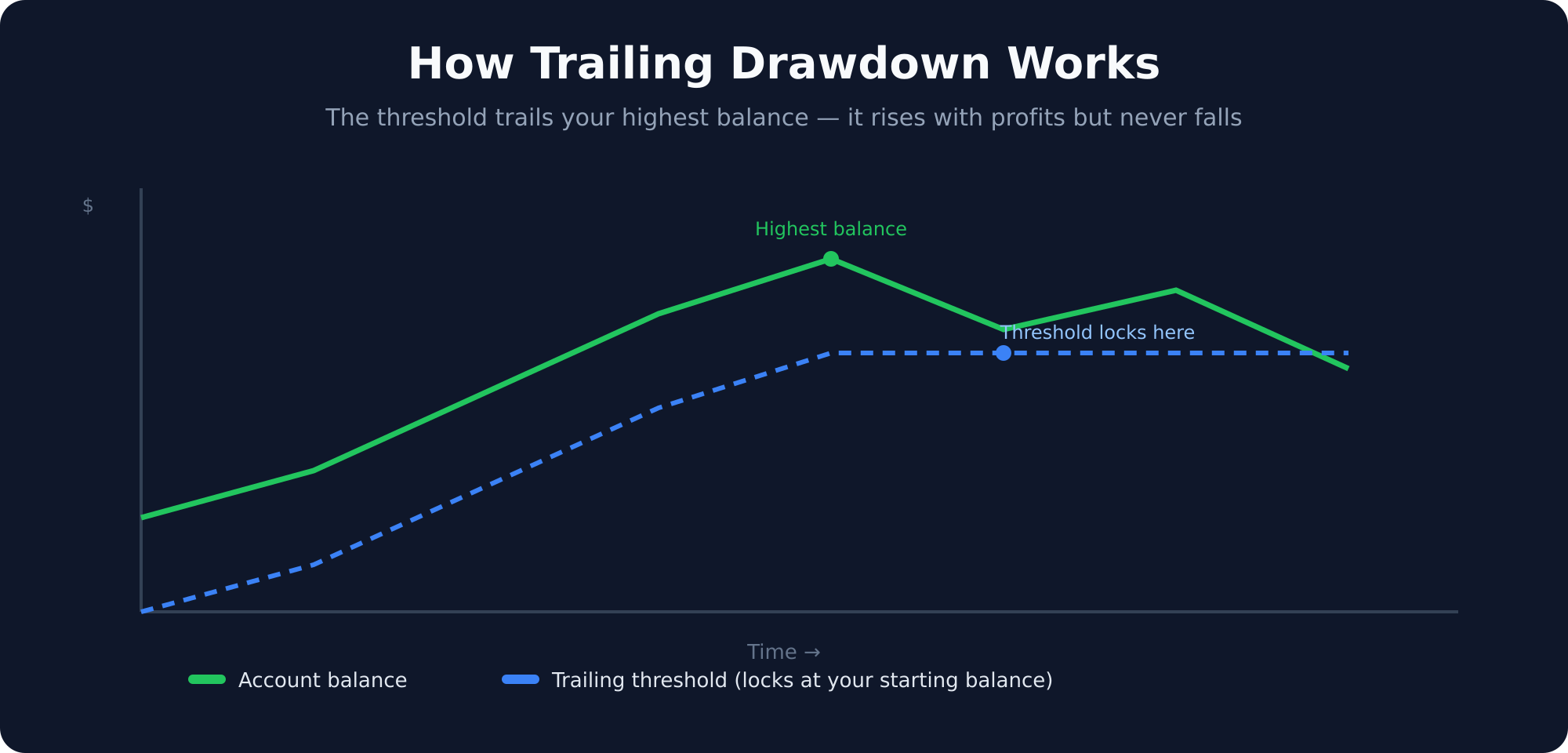
This is the rule that catches most new prop firm traders off guard. You can be profitable overall and still breach your maximum drawdown because of how the trailing mechanism works.
How Trailing Drawdown Works: A Simple Example
You start a $50K Topstep Combine. Your Maximum Loss Limit is $2,000, meaning your account cannot drop below $48,000. Topstep trails it on end-of-day balances and monitors breaches in real time, including unrealised P&L.
- Day 1: You make $1,500. Your account is now $51,500. Your trailing drawdown limit moves up to $49,500.
- Day 2: You make another $1,000. Account: $52,500. Drawdown limit: $50,500.
- Day 3: Market goes against you and you lose $2,200. Account: $50,300. You are still above $48,000 — but you are BELOW your current drawdown limit of $50,500. Your Combine ends.
You made money overall ($300 net positive from day 1 start) but still failed the evaluation because the trailing drawdown caught the intraday loss on day 3.
When Does the Trailing Drawdown Lock?
Whether and where a trailing drawdown stops trailing depends on the firm and the account stage, so read your firm’s current parameters rather than relying on a rule of thumb. The bigger difference between firms is what the drawdown trails: end-of-day balances or intraday equity.
Topstep trails on end-of-day balances, so an intraday run-up you give back before the close does not move your floor. Apex’s Full evaluation, according to recent rule guides, trails peak unrealised equity in real time — open profit you give back still raises the floor. Take Profit Trader uses end-of-day trailing in its Test but intraday trailing in its funded PRO account.
Trailing Drawdown vs Daily Loss Limit
These are two different rules that operate independently:
- Daily loss limit (DLL): resets every day. Breach it and your account is paused for that day (or permanently, depending on the firm).
- Trailing drawdown: does not reset. It measures your account balance versus its peak. You can have multiple profitable days and still be at risk of breaching trailing drawdown on one bad afternoon.
Most traders focus too much on the DLL and not enough on trailing drawdown management. A day where you stay within the DLL can still move your trailing drawdown limit up, tightening your safety net for the next session.
Strategies to Manage Trailing Drawdown
Withdraw Frequently
At prop firms that allow or encourage withdrawals, taking money off the table reduces your peak balance and therefore your trailing drawdown exposure. Some firms reset the trailing drawdown calculation on withdrawal — check your firm's specific rules.
Set a Personal Drawdown Limit Below the Firm's
If your trailing drawdown limit is currently at $49,500, set your personal stop for the day at $50,000. Leaving $500 of buffer means slippage or an unexpected news move will not cause an accidental breach.
Trade Smaller After Big Green Days
After a very profitable day, your trailing drawdown limit has moved up and your safety net is tighter. This is the wrong time to press your size. Reduce contract count by 25–50% for the session following a large profit day.
Understand Your Firm's Lock Level
Know whether your firm’s drawdown stops trailing at some level, and whether it trails end-of-day or intraday. Once a drawdown stops trailing, your risk management shifts from "avoid the trail" to "protect a fixed floor."
How Copy Trading Affects Trailing Drawdown
When you copy trade to multiple funded accounts, each account has its own trailing drawdown that moves independently. A profitable leader account might push several follower accounts into a higher trailing drawdown zone simultaneously. Signal Trade App lets you set per-account daily loss limits that automatically pause copying before an account approaches its trailing drawdown limit — protecting each funded account independently, even when they are all following the same leader.
Ready to Master Trailing Drawdown?
Trailing drawdown is one of the most misunderstood prop firm rules. Signal Trade App handles the complexity automatically — monitor peak equity, enforce per-account limits, and protect each funded account independently while copying across your entire portfolio.
Related Reading
How to pass Topstep evaluation
Frequently Asked Questions
What is a trailing drawdown?
A maximum loss threshold that moves up as your account reaches new highs and never moves down. You can be profitable overall and still breach it after giving back gains.
Does Topstep use end-of-day or intraday trailing drawdown?
End-of-day. Topstep’s Maximum Loss Limit ($2,000 on a 50K Combine) trails end-of-day balances and is monitored in real time, including unrealised P&L.
Why is Trailing Drawdown Explained important?
Understanding this topic helps you trade more efficiently, manage risk, and scale across multiple accounts.
Start Copy Trading Free
Signal Trade App lets you copy one trade across unlimited prop firm accounts in under 50ms. Sign up free with a 5-day Pro trial (credit card required, no charge during trial).
Related Reading
- Help Center — Setup guides, broker connections, and risk management
- Supported Platforms — Tradovate, NinjaTrader, TradingView, and more
- Blog — More guides on copy trading, prop firms, and futures automation