OTE Trading Strategy: How to Find Optimal Trade Entries in Futures
Category: Strategy | Date: 2026-05-06
What Is OTE in Trading?
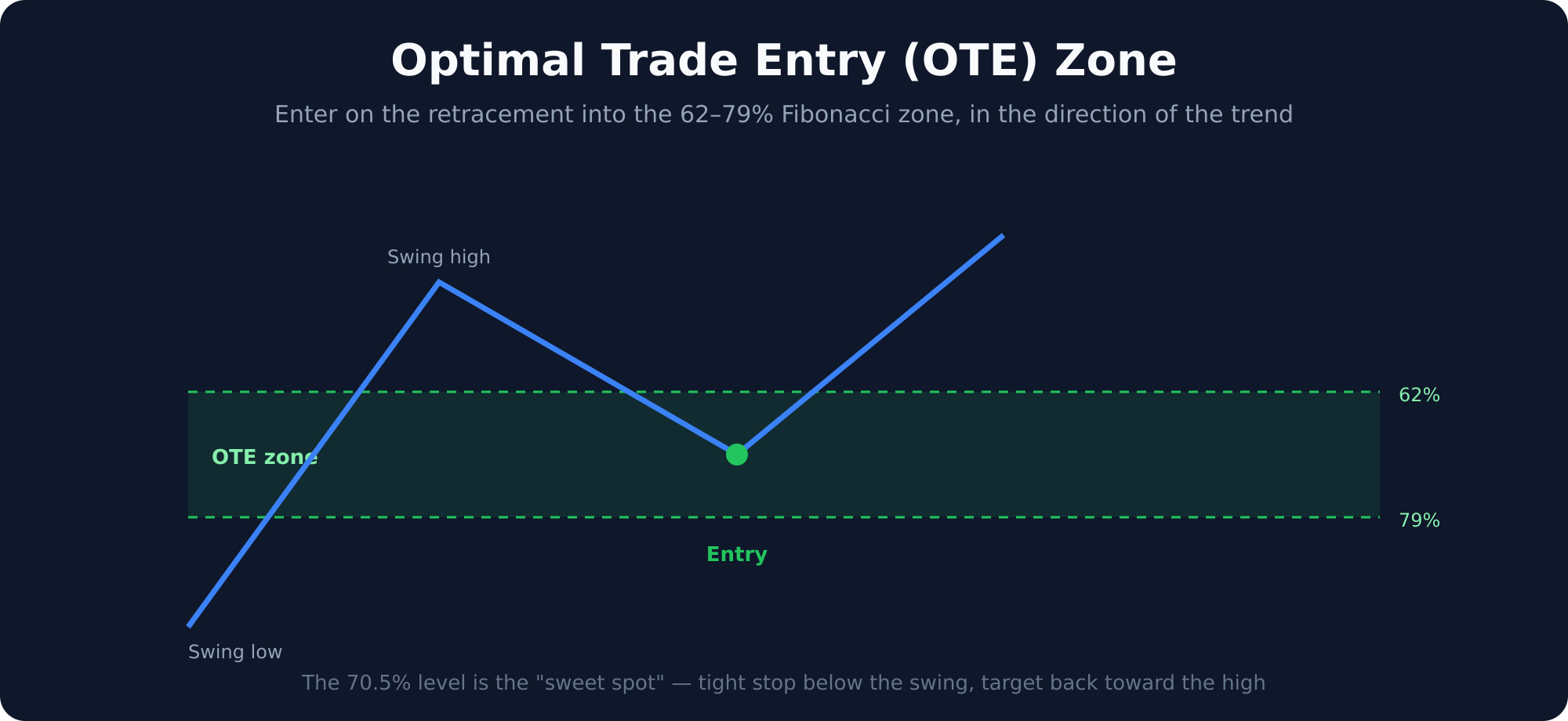
OTE stands for Optimal Trade Entry — a precision entry technique popularized by the Inner Circle Trader (ICT) methodology. The core idea is simple: instead of chasing breakouts or entering at random prices, you wait for price to retrace to a specific structural level where institutional orders are likely resting, then enter with the highest probability and lowest risk.
In futures trading, where a single tick on NQ is worth $5 and slippage can erase edge, knowing your exact entry zone before the market reaches it is not optional — it is the difference between profitable consistency and random results.
The 50% Retracement Rule
The most common OTE level is the 50% retracement of a recent impulsive move. If price rallies from 20,000 to 20,100, the OTE zone sits around 20,050. The logic is that institutional algorithms often reload positions at the midpoint of a swing, creating a high-probability reversal zone.
But the 50% level alone is not enough. OTE traders combine the retracement with other structural confluences: fair value gaps, order blocks, and breaker levels. The more confluence at the 50% zone, the higher the conviction.
Fair Value Gaps and OTE
A fair value gap (FVG) is an imbalance in price action — a candle's wick that leaves a void between the previous candle's high and the next candle's low. These gaps act as magnets for price. When the 50% retracement aligns with an FVG, the OTE zone becomes significantly more potent.
On the NQ 1-minute chart, FVGs form constantly during the New York session. An OTE trader marks the FVG, waits for price to retrace to the 50% level inside the gap, and enters with a tight stop below the gap's low. The risk is small; the reward is the next impulsive leg.
How to Calculate OTE Levels for Futures
Calculating OTE is straightforward arithmetic, but precision matters when you are trading multiple contracts across prop firm accounts:
- Identify the impulsive leg: measure from the swing low to the swing high (for longs) or high to low (for shorts).
- Calculate 50% of the leg: (High + Low) / 2.
- Mark the fair value gap within the leg using the wick-to-wick method.
- Confirm confluence: does the 50% level overlap with the FVG, an order block, or a previous breaker?
- Set your entry order at the OTE zone with a stop 2–4 ticks beyond the structural low and a target at the next liquidity pool.
Signal Trade App helps here in two ways. First, you can set bracket orders with precise tick-sized stops and targets directly in the platform — no manual calculation errors. Second, when your OTE setup triggers, the trade copies instantly to all your follower accounts, ensuring every prop firm account fills at the same optimal price.
OTE on NQ vs ES vs MNQ
OTE works on every futures instrument, but the tick size and volatility change the execution:
- NQ (E-Mini Nasdaq): $5 per tick, 80–150 point daily range. OTE zones are wider; stops need 10–20 ticks of breathing room.
- MNQ (Micro Nasdaq): $0.50 per tick, same range as NQ. Ideal for learning OTE with real risk but micro-sized losses.
- ES (E-Mini S&P 500): $12.50 per tick, 20–40 point daily range. OTE zones are tighter; 5–10 tick stops are common.
Beginners should master OTE on MNQ before scaling to NQ or ES. The mechanics are identical, but the dollar consequence of a mistimed entry is one-tenth the size.
Risk Management with OTE
OTE is not a magic bullet. Price can and does violate the 50% level, especially during high-volatility sessions like FOMC or NFP. Your risk management must account for this:
- Never risk more than 1% of your account on a single OTE setup.
- Use the FVG low (not the OTE level) as your technical stop.
- If price retraces beyond 62% of the leg, the setup is invalid — exit and wait for a new structure.
- Track your OTE win rate in a journal. If it drops below 55% for 20 trades, your FVG identification or confluence reading needs adjustment.
Signal Trade App's built-in trading journal auto-imports every OTE trade with entry price, stop, target, fill time, and P&L. You can filter by symbol, side, and setup type to see whether your OTE entries are actually profitable — or just theoretically elegant.
Scaling OTE Across Prop Firm Accounts
The real power of OTE comes from scaling. When you identify a high-confluence OTE zone on NQ, you want every funded account to participate — not just one. Signal Trade App copies your OTE entry from the leader account to unlimited followers in under 50ms. Each follower can have its own copy ratio, so your $50K Lucid account trades 1 MNQ while your $150K Apex account trades 3 MNQ — all from the same OTE signal.
For trading educators and affiliate marketers, this is a compelling story. You can demonstrate OTE setups on a live stream, show the Signal Trade App dashboard copying the trade to five prop firm accounts simultaneously, and offer your audience a free trial of the copier. Every referral who upgrades to Pro earns you a 10% recurring commission — indefinitely.
OTE is not about predicting the market. It is about positioning yourself where the market is most likely to reverse — and having the infrastructure to exploit that edge across every account you own.
Ready to Scale Your OTE Setups?
Signal Trade App copies your OTE entries to every prop firm account simultaneously with custom copy ratios per account. Identify the setup once on your leader, execute across your entire funded portfolio instantly.
Frequently Asked Questions
What is OTE Trading Strategy?
Learn the OTE (Optimal Trade Entry) trading strategy for futures markets. Discover how to calculate OTE levels, use fair value gaps, and execute precise entries on NQ, ES, and MNQ with Signal Trade App.
How does OTE Trading Strategy work?
It depends on the specific setup, but the article explains the mechanics, rules, and best practices. Learn the OTE (Optimal Trade Entry) trading strategy for futures markets. Discover how to calculate OTE levels, use fair value gaps, and execute precise entries on NQ, ES, and MNQ with Signal Trade App.
Why is OTE Trading Strategy important?
Understanding this topic helps you trade more efficiently, manage risk, and scale across multiple accounts.
Start Copy Trading Free
Signal Trade App lets you copy one trade across unlimited prop firm accounts in under 50ms. Sign up free with a 5-day Pro trial (credit card required, no charge during trial).
Related Reading
- Help Center — Setup guides, broker connections, and risk management
- Supported Platforms — Tradovate, NinjaTrader, TradingView, and more
- Blog — More guides on copy trading, prop firms, and futures automation