Inverse Trading: Can Running Opposite Trades Make You a Better Trader?
Category: Strategies | Date: 2026-06-14
What Is Inverse Trading?
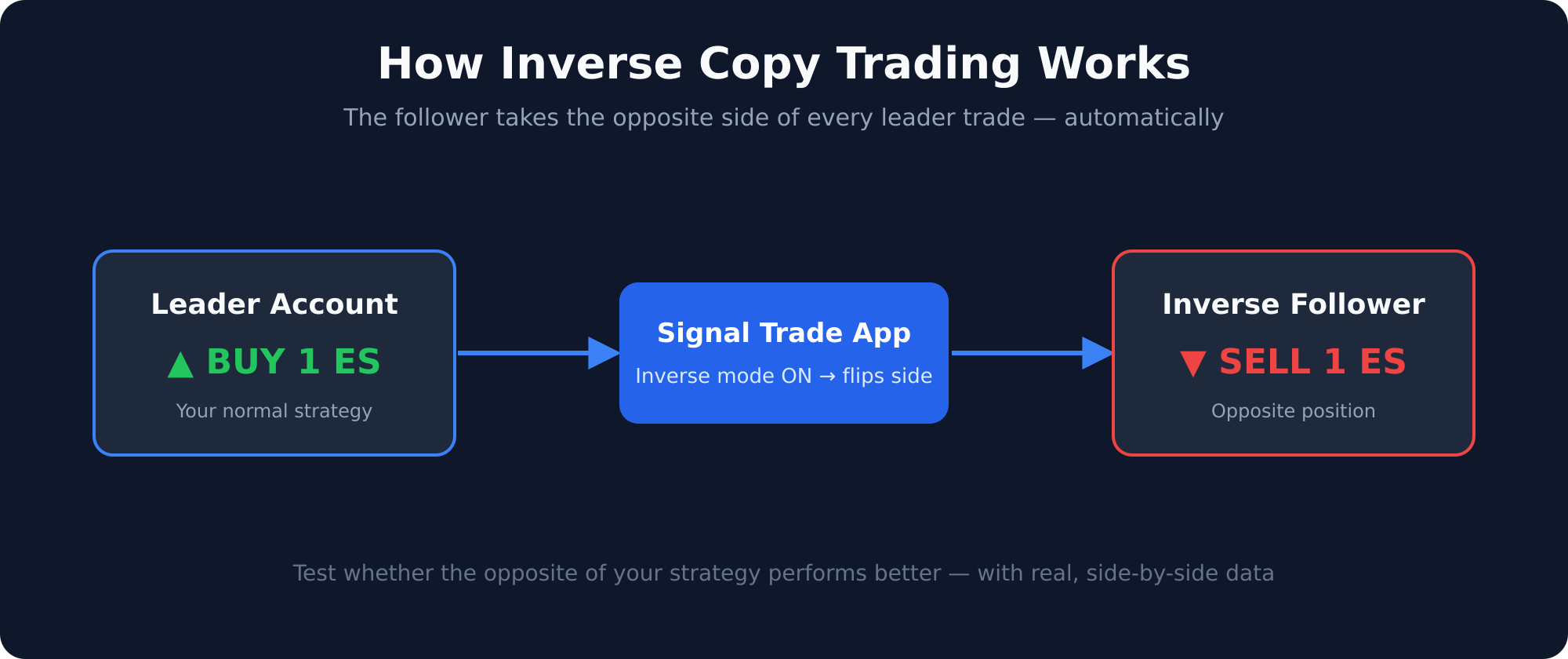
Inverse trading is the practice of taking the opposite side of a trading signal. If your strategy says buy, the inverse position sells. If your strategy says sell, the inverse position buys. With Signal Trade App, you can automate inverse copying so that one leader account generates opposite trades on a follower account at a different broker or prop firm.
Traders use inverse copying for a few reasons: to test whether their strategy is systematically wrong, to hedge directional risk across accounts, or to run a "contrarian" experiment without manually flipping every trade.
The "Am I Always Wrong?" Test
Many struggling traders notice a pattern: they find a setup, take the trade, and the market immediately moves against them. The impulse is to keep refining entries, indicators, and risk rules. But sometimes the simpler test is to ask: what if I did the exact opposite?
Inverse copying lets you answer that question with real data. You open a second account at a different prop firm, connect it as a follower, enable inverse mode, and let the software flip every signal. After a sample of trades, you can compare the equity curves side by side.
This is not a magic fix. It is a diagnostic tool. If the inverse account performs significantly better, your original strategy may have a structural bias — perhaps overtrading a fading trend, poor timing, or asymmetric risk. If both lose, the problem is likely fees, slippage, or market conditions rather than direction.
How Inverse Copying Works in Signal Trade App
Signal Trade App connects a leader account to follower accounts. Normally, every order on the leader is replicated on followers with the same direction and adjusted quantity. With inverse mode enabled on a follower, the software inverts the order side before sending it to that account.
- Leader buys 1 ES → inverse follower sells 1 ES.
- Leader sells 2 NQ → inverse follower buys 2 NQ.
- Stop losses and take profits are also inverted relative to entry.
- Bracket adjustments follow the inverted position.
- Risk limits still apply per follower account.
Setting Up an Inverse Trade Experiment
- Identify the leader account you want to test.
- Open or select a follower account at a different prop firm or broker.
- Create a copy group and add the follower.
- Enable inverse mode on the follower.
- Set a small fixed quantity or reduced copy ratio to limit risk.
- Set daily loss limits on both accounts.
- Run the experiment for a defined number of trades or days.
- Compare P&L, drawdown, and win rate between leader and inverse follower.
What the Numbers Can Tell You
After 20–50 matched trades, the comparison usually falls into one of three patterns:
- Leader wins, inverse loses → your original direction is likely valid. The problem may be sizing, psychology, or execution.
- Leader loses, inverse wins → your directional read is systematically inverted. This is valuable feedback — you may be fighting the trend, misreading entries, or using lagging signals.
- Both lose → commissions, slippage, fees, or choppy market conditions are eating both sides. The issue is not direction.
Use this information to change one variable at a time in your main strategy. Inverse trading is a mirror, not a strategy in itself.
Risk Management Is Still Required
Running opposite trades does not remove risk. If the market trends strongly, both accounts can lose if slippage, fees, or stop distances differ. Inverse copying should be treated like any other strategy test: small size, hard daily loss limits, and a clear stop point for the experiment.
Never run inverse mode on a live funded account at full size just to "see what happens." Use evaluation accounts or the smallest position size your prop firm allows.
Common Use Cases
- Diagnosing a strategy that loses consistently despite logical entries.
- Comparing execution quality across two prop firms using the same underlying trades.
- Testing whether a lagging indicator produces inverted entries that outperform.
- Creating a rough hedge when a trader has directional uncertainty but wants market exposure.
- Running a controlled experiment to remove confirmation bias from manual trading.
Scenarios Where Inverse Trading Can Work
Scenario 1: The Consistently Wrong Directional Trader
Alex trades NQ futures using a breakout strategy. Over 40 trades, his original account loses $2,400. He suspects he enters too late and that breakouts often reverse immediately. He opens a $50K evaluation account at a second prop firm, connects it as an inverse follower with the same 1-lot sizing, and runs the same signals for the next 40 trades.
The inverse account finishes the sample up $1,800. The difference is not random — Alex realizes his entries are consistently late to breakouts and that fading the move, entering smaller, or waiting for pullback confirmation would improve results. He uses the data to adjust his main strategy instead of blindly switching to inverse trading.
Scenario 2: The Lagging Indicator Problem
Maria uses a moving-average crossover system on ES. Her backtests look good, but live results are poor. She suspects the indicator lags too much in fast-moving futures. She sets up an inverse follower on a micro-ES account at a different firm and runs the same crossover signals.
After 30 matched trades, the inverse account loses less than the original account. This tells Maria the crossover itself is the problem — not her execution. She stops trading the system and switches to a faster entry model, saving herself from additional losses on both sides.
Scenario 3: Execution and Slippage Comparison
Jordan runs a scalping strategy on Apex using NinjaTrader/Rithmic. He notices his fills are worse than expected during fast open ranges. He opens an account at Take Profit Trader, also on Rithmic, and runs the same leader as an inverse follower with identical risk settings.
Both sides lose money, but the inverse account loses slightly less due to better fills at the second firm. Jordan discovers the original problem is a mix of prop firm execution and his tight stops. He increases his stop buffer slightly and moves more size to the firm with better fills.
Scenario 4: The Psychology Reset
Chris has been revenge trading and overriding his strategy. Every time the strategy takes a loss, he hesitates on the next entry or exits early, making results worse. He sets up an inverse evaluation account to run the exact opposite of every signal with no manual intervention.
The inverse account follows rules perfectly while Chris continues to interfere with the original account. The comparison reveals that the strategy is actually close to break-even before his psychology destroys it. Chris uses this insight to reduce size, add automation, and stop overriding entries.
Limitations and Honest Warnings
Inverse trading is not a guaranteed way to turn a losing strategy into a winning one. Slippage, commissions, and bid-ask spreads affect both sides. A strategy that loses on one side can still lose on the other if the edge is negative after costs.
Also, inverse mode flips the order side, not the strategy logic. It does not account for market context, news events, or changing volatility. Use it as a testing and risk management feature, not as a standalone trading system.
Questions to Ask Yourself Before Trying Inverse Trading
If you are considering inverse copying, answer these questions honestly:
- Have I tracked at least 50 trades of my current strategy with clear rules?
- Am I losing because of direction, execution, fees, or psychology?
- Can I afford to lose the small amount allocated to the inverse test?
- Do I have daily loss limits set on both accounts?
- Will I stop the experiment if the results are unclear after the planned sample size?
- Am I using evaluation accounts or the smallest size possible?
- Do I understand that inverse mode flips signals but does not fix a broken strategy?
Start Testing With Inverse Copying
If you are stuck in a losing streak and cannot identify why, inverse copying can give you objective feedback. Set up a small follower account at a different firm, enable inverse mode, and let the data show you whether the problem is direction, execution, or costs.
Frequently Asked Questions
1. What does inverse trade copying do?
It flips the direction of every trade sent to a follower account. A buy on the leader becomes a sell on the follower, and vice versa.
2. Is inverse trading the same as hedging?
Not exactly. Hedging usually offsets an existing position to reduce risk. Inverse copying independently takes the opposite side across a separate account, which can act like a hedge but is primarily a diagnostic tool.
3. Can inverse trading guarantee profits?
No. After costs, both sides can lose. It is a test, not a profit guarantee.
4. Why would I run opposite trades at a different prop firm?
Different firms have different fees, platforms, and execution speeds. Testing at a second firm also isolates whether poor results are due to your strategy or the broker environment.
5. How many trades do I need to compare?
A minimum of 20–30 matched trades is a starting point. More is better, but do not extend the experiment beyond your planned risk limit just to gather data.
6. Does inverse mode affect stop losses and take profits?
Yes. Brackets are inverted relative to the entry. A long stop becomes a short stop, and the take profit is placed on the opposite side.
7. Can I use inverse mode on a funded account?
You can, but it is safer to test on evaluation accounts first. Running inverse on a funded account should use the smallest size allowed.
8. What markets work best for inverse testing?
Liquid markets with tight spreads work best because costs are lower. Thin or highly volatile markets can produce different fills on each side.
9. Will inverse copying work with micro contracts?
Yes, as long as both accounts support the same symbol. Micro contracts are ideal for small-size experiments.
10. Can I run multiple inverse followers at once?
Yes. You can have one leader and multiple followers, some normal and some inverse, across different firms.
11. How is inverse mode different from a stop-and-reverse strategy?
A stop-and-reverse strategy flips a position within the same account. Inverse copying sends opposite signals to a separate account while the leader keeps its original direction.
12. Do prop firms allow inverse copying?
Most prop firms allow independent trades in separate accounts. However, copying or coordinating trades across accounts may violate specific firm rules. Check each firm’s terms of service.
13. Can inverse trading help if I am always wrong?
It can reveal whether your directional bias is inverted, but being "always wrong" is rare. Usually there is a mix of execution, risk, and market-structure issues.
14. How do I set daily loss limits on the inverse account?
In Signal Trade App, set per-follower risk controls such as daily loss limit, max quantity, and profit target before enabling inverse mode.
15. Is inverse trading suitable for beginners?
Beginners should focus on learning one clean strategy first. Inverse copying is an advanced tool for diagnosing edge or testing execution differences.
Start Copy Trading Free
Signal Trade App lets you copy one trade across unlimited prop firm accounts in under 50ms. Sign up free with a 5-day Pro trial (credit card required, no charge during trial).
Related Reading
- Help Center — Setup guides, broker connections, and risk management
- Supported Platforms — Tradovate, NinjaTrader, TradingView, and more
- Blog — More guides on copy trading, prop firms, and futures automation