How to Pass a Prop Firm Evaluation: 6 Rules That Actually Work
Category: Prop Firms | Date: 2026-06-04
Why Most Traders Fail Evaluations
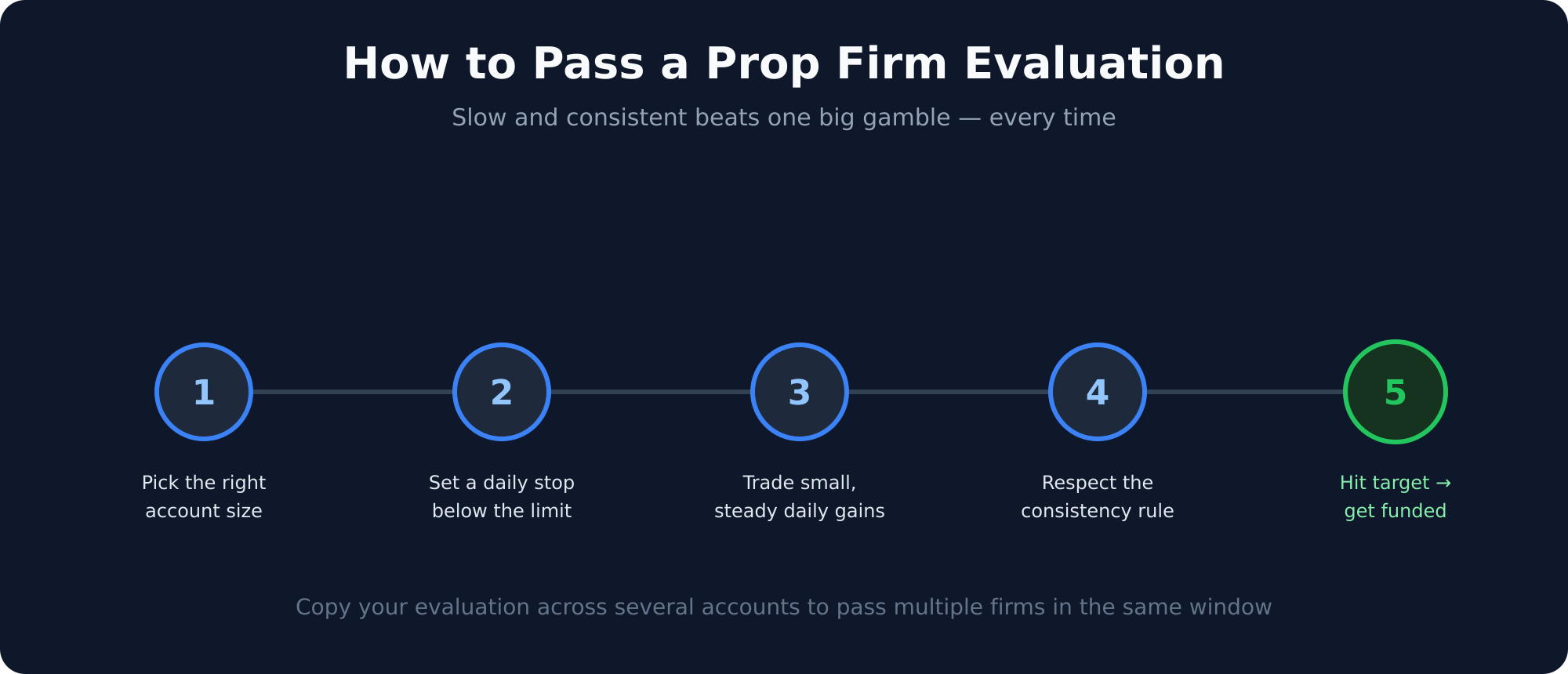
Prop firm evaluations are designed to filter out undisciplined traders. The firms do not care if you are occasionally profitable — they care if you can generate consistent returns without blowing their capital. Most evaluation failures are not caused by bad strategy. They are caused by poor risk management, emotional trading, and ignorance of the rules.
These six rules are not theory. They are the distilled habits of traders who pass evaluations repeatedly and build long-term funded accounts.
Rule 1: Trade Micro Contracts Until You Are Consistent
The fastest way to fail an evaluation is oversized position entry. A $50K evaluation with a $1,000 daily loss limit can be blown with two bad NQ trades if you are trading full-size contracts.
Start every evaluation with micro contracts — MNQ, MES, or MGC. A 10-point stop on MNQ costs $20. The same stop on NQ costs $200. You can afford to be wrong five times on MNQ for every one wrong trade on NQ. Micros let you survive long enough for your edge to play out.
Rule 2: Cap Your Daily Profit to Avoid the Consistency Rule
Many firms apply a consistency rule to evaluations. At Topstep your best day should stay at or below 55% of the profit target — on a $3,000 target, a day above $1,650 raises the target instead of failing you. Take Profit Trader holds your pass until no single day exceeds 50% of total profit.
The fix is counterintuitive: stop trading once you hit $800–$900 on a $50K evaluation. Leave money on the table today to pass the evaluation tomorrow. Once funded, most consistency rules disappear or relax — that is when you press for larger days.
Rule 3: Set Your Personal Daily Loss Limit at 80% of the Firm's Rule
If the firm allows a $1,000 daily loss, your personal stop should be $800. That $200 buffer protects you from:
- Slippage on stop orders during fast markets
- Platform lag between your stop trigger and execution
- One final revenge trade that pushes you from -$950 to -$1,050
- Data feed discrepancies between your chart and the firm's risk engine
Never treat the firm's daily loss limit as your stop. It is a hard ceiling, not a target.
Rule 4: Skip the First 30 Minutes After Market Open
The first 30 minutes of the New York session (9:30–10:00 AM ET) are the most chaotic period in futures. Overnight gaps fill, algorithms rebalance, and retail stop sweeps are common. The ranges are wide, the noise is high, and the probability of getting stopped out on a good setup is elevated.
Wait for the initial volatility to settle. Most profitable prop firm traders do not place their first trade until after 10:00 AM ET. Patience at the open preserves capital for higher-probability setups later in the session.
Rule 5: Do Not Trade High-Impact News Events
FOMC announcements, Non-Farm Payrolls, and CPI releases can move NQ 50–100 points in under a minute. Even if your directional bias is correct, the spread widening and platform freezes around news can stop you out before the real move begins.
Check the economic calendar before each session. If a high-impact event is scheduled during your trading window, either trade before it and flatten five minutes prior, or sit out entirely. Prop firms do not reward bravery — they reward consistency.
Rule 6: Demo Test Your Setup Before Risking Evaluation Fees
Every evaluation costs money. Before you purchase a Topstep Combine ($49/month for 50K plus a $149 activation fee, or $95/month with none) or an Apex evaluation, run your exact strategy on a demo account for two full weeks. Verify that:
- Your entry criteria produce positive expectancy in current market conditions.
- Your stop distances do not exceed your personal daily loss limit on normal losing days.
- Your profit targets are achievable within the consistency rule constraints.
- Your trade copier copies correctly if you plan to use one on funded accounts.
Signal Trade App's 5-day free trial lets you copy trades across demo or live accounts at no cost. Test your copy group configuration, risk rules, and bracket order behavior before risking evaluation capital. Two weeks of flawless demo performance is worth more than ten impulsive evaluation purchases.
The Evaluation Is the Filter, Not the Finish Line
Passing the evaluation proves you can follow rules. Staying funded proves you can generate returns. The traders who treat evaluations as a discipline test — not a profit chase — are the ones who build sustainable prop firm careers.
Signal Trade App helps after you pass. Copy your funded account to additional evaluations, scale across multiple prop firms, and enforce daily loss limits automatically so you never breach a firm's rule because of one emotional afternoon.
Pass the evaluation with discipline. Scale with automation. Keep the profits with patience.
Frequently Asked Questions
How do I Pass a Prop Firm Evaluation?
Pass your prop firm evaluation on the first try with these 6 proven rules. Covers risk limits, consistency rules, news avoidance, and setup discipline for Topstep, Apex, and more.
What do I need to Pass a Prop Firm Evaluation?
You need a compatible broker or prop firm account, a trade copier if you are scaling, and a clear risk plan. Pass your prop firm evaluation on the first try with these 6 proven rules. Covers risk limits, consistency rules, news avoidance, and setup discipline for Topstep, Apex, and more.
How long does Pass a Prop Firm Evaluation take?
It depends on your preparation and market conditions, but most traders can set it up in under an hour and refine it over a few sessions.
Why Most Traders Fail Evaluations?
Prop firm evaluations are designed to filter out undisciplined traders. The firms do not care if you are occasionally profitable — they care if you can generate consistent returns without blowing their capital.
What is Rule 1: Trade Micro Contracts Until You Are Consistent?
The fastest way to fail an evaluation is oversized position entry. A $50K evaluation with a $1,000 daily loss limit can be blown with two bad NQ trades if you are trading full-size contracts.
What is Rule 2: Cap Your Daily Profit to Avoid the Consistency Rule?
Many firms apply a consistency rule to evaluations. At Topstep your best day should stay at or below 55% of the profit target; exceed it and the target rises. Take Profit Trader holds your pass until no single day exceeds 50% of total profit.
Start Copy Trading Free
Signal Trade App lets you copy one trade across unlimited prop firm accounts in under 50ms. Sign up free with a 5-day Pro trial (credit card required, no charge during trial).
Related Reading
- Help Center — Setup guides, broker connections, and risk management
- Supported Platforms — Tradovate, NinjaTrader, TradingView, and more
- Blog — More guides on copy trading, prop firms, and futures automation