Daily Loss Limit Strategy: How to Stay Under Prop Firm Rules
Category: Risk Management | Date: 2026-05-06
Why Daily Loss Limits Matter
The daily loss limit (DLL) is the single most important number in prop firm trading. Breach it and your evaluation ends — or your funded account gets closed. Yet most traders treat the DLL as a suggestion rather than a hard stop.
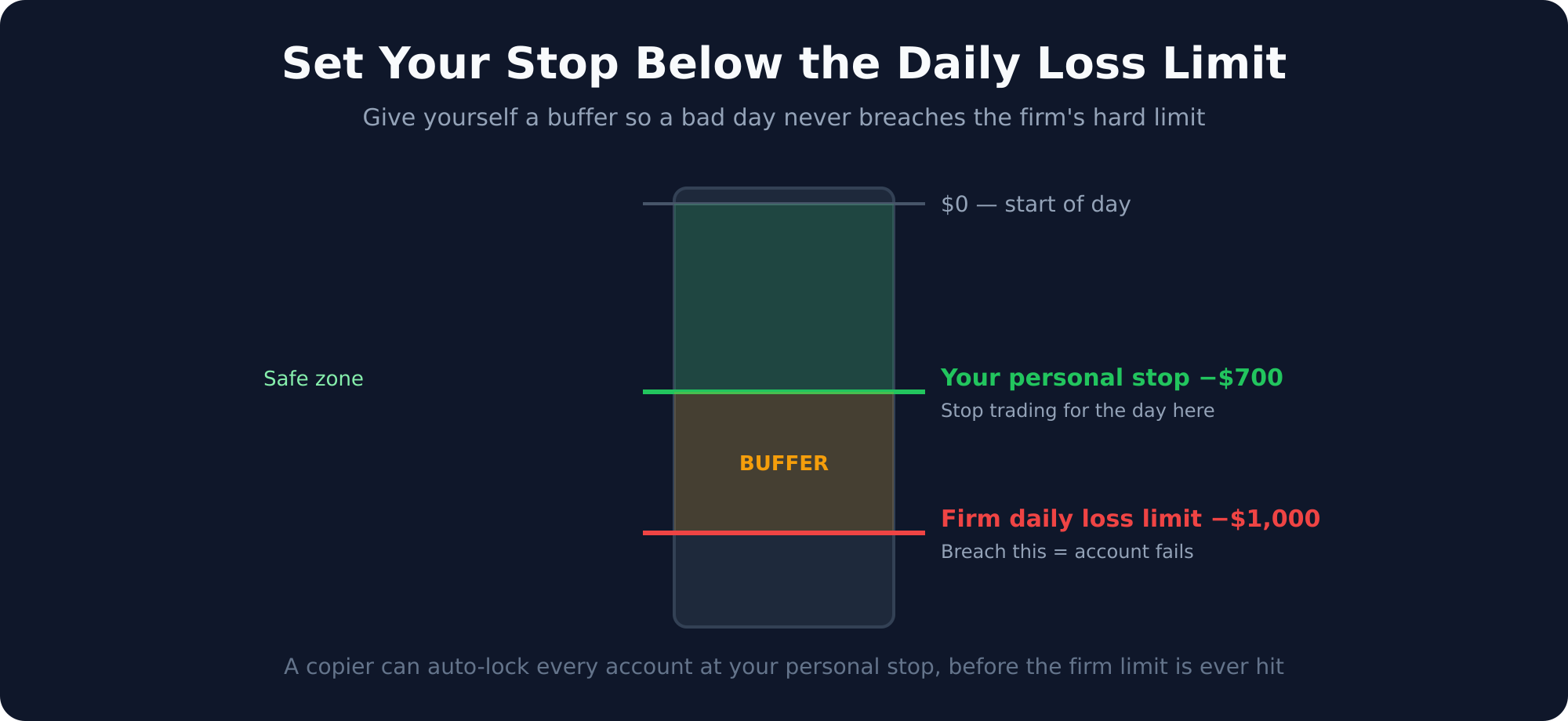
This guide shows you how to set personal daily loss limits well below your prop firm's official rule, automate enforcement, and structure your position sizing so you never accidentally breach.
The 80% Rule
Never use the prop firm's official DLL as your stop. If the firm allows -$1,000, your personal daily stop should be -$800. That $200 buffer protects you from:
- Slippage on stop orders in fast markets
- Platform lag between your stop trigger and execution
- A final revenge trade that pushes you from -$950 to -$1,050
- Data feed discrepancies between your chart and the firm's risk engine
Position Sizing Around the DLL
Your maximum position size should be determined by your DLL, not by how confident you feel. The formula is simple:
Max Contracts = (Daily Loss Limit × 0.8) ÷ (Stop Distance in Ticks × Tick Value)
Example: You have a $1,000 DLL and trade MNQ with a 20-tick stop. MNQ is $0.50 per tick.
Max contracts = ($1,000 × 0.8) ÷ (20 × $0.50) = $800 ÷ $10 = 80 contracts.
In practice, you should trade far fewer than the theoretical maximum. A good rule is to risk no more than 2% of your DLL on any single trade.
The Three-Strike Rule
Even with perfect position sizing, consecutive losses can add up. Implement a three-strike rule:
- Strike 1: First losing trade of the day. Reduce position size by 25% for the next trade.
- Strike 2: Second losing trade. Reduce position size by 50%. Only take A+ setups.
- Strike 3: Third losing trade. Stop trading for the day. The market is not aligned with your strategy.
This rule prevents the "just one more trade to get back to breakeven" spiral that destroys accounts.
Automating Daily Loss Limits
Manual discipline is unreliable. Automation enforces your rules while you are emotional. Signal Trade App offers three layers of automated protection:
- Platform-level DLL: Set a dollar limit per account. When breached, copying pauses instantly.
- Profit target lock: Optionally stop copying once a daily profit target is hit to protect gains.
- Max quantity limits: Prevent oversized entries even when you are not thinking clearly.
These limits apply per follower account. A leader account can keep trading while a follower that hit its DLL stops copying — protecting the funded account without affecting the rest of your group.
DLLs for Multiple Accounts
When copying to 10 accounts, each account has its own DLL. A $1,000 DLL on 10 accounts means your total daily risk is $10,000. This is not a problem if your strategy is profitable — but it means your combined exposure is 10x your single-account risk.
Consider lowering per-account DLLs when scaling. If you normally use $800 personal stops, use $600 on followers to create an extra safety margin.
The traders who survive prop firm evaluations are not the ones with the best strategy — they are the ones with the best risk rules.
Ready to Automate Your Daily Loss Limits?
Signal Trade App enforces daily loss limits at the platform level across all your accounts. Set it once, copy with confidence. No willpower required — just automation.
Frequently Asked Questions
What is Daily Loss Limit Strategy?
Learn how to set and enforce daily loss limits that keep you inside prop firm rules. Protect your funded accounts with automatic lockouts and smart risk sizing.
How does Daily Loss Limit Strategy work?
It depends on the specific setup, but the article explains the mechanics, rules, and best practices. Learn how to set and enforce daily loss limits that keep you inside prop firm rules. Protect your funded accounts with automatic lockouts and smart risk sizing.
Why is Daily Loss Limit Strategy important?
Understanding this topic helps you trade more efficiently, manage risk, and scale across multiple accounts.
Why Daily Loss Limits Matter?
The daily loss limit (DLL) is the single most important number in prop firm trading. Breach it and your evaluation ends — or your funded account gets closed. Yet most traders treat the DLL as a suggestion rather than a hard stop.
What is 80% Rule?
Never use the prop firm's official DLL as your stop. If the firm allows -$1,000, your personal daily stop should be -$800. That $200 buffer protects you from:
What is Position Sizing Around the DLL?
Your maximum position size should be determined by your DLL, not by how confident you feel. The formula is simple: Example: You have a $1,000 DLL and trade MNQ with a 20-tick stop. MNQ is $0.50 per tick.
Start Copy Trading Free
Signal Trade App lets you copy one trade across unlimited prop firm accounts in under 50ms. Sign up free with a 5-day Pro trial (credit card required, no charge during trial).
Related Reading
- Help Center — Setup guides, broker connections, and risk management
- Supported Platforms — Tradovate, NinjaTrader, TradingView, and more
- Blog — More guides on copy trading, prop firms, and futures automation